It is anticipated that the new UPLOADS App will be released on 1 August 2018.
To register your interest in participating in the research project and using the App, please contact the UPLOADS Team.
It is anticipated that the new UPLOADS App will be released on 1 August 2018.
To register your interest in participating in the research project and using the App, please contact the UPLOADS Team.
Title: Beyond Likelihood and Consequence: Developing a Systems Approach to Risk Assessment in the Led Outdoor Activity Context
Abstract:
Inadequate risk assessment has often been highlighted as a contributing factor in the injuries and deaths of participants on led outdoor activity (LOA) programs in Australia, and internationally. The field of safety science considers that accidents in complex safety-critical domains (e.g. LOA’s, healthcare, aviation) are caused by a combination of decisions and actions of multiple actors situated across the system, not just by any actors working at the so-called sharp end of practice (e.g. instructor, pilot or nurse). Prior to this program of research, it was unclear as to whether this systems thinking perspective had been translated across to risk assessment practice. To address this gap, a literature review of current risk assessment methods was conducted, followed by a survey of current risk assessment practice, the subsequent development and application of a new systems thinking-based risk assessment method, and finally, testing of the method’s reliability and validity. The studies found that current risk assessment methods and practice are not consistent with systems thinking, that existing risk assessment methods are limited in their ability to identify system wide risks, and that the new risk assessment method (the NETworked Hazard Analysis and Risk Management System; NET-HARMS) is capable of identifying systemic risks as well as emergent risks. Further, formal reliability and validity testing of NET-HARMS demonstrated that risk assessment may be enhanced by involving multiple analysts from across the work system in the process. These findings have important implications for risk assessment activities being conducted within complex safety-critical domains.
Bio: Clare Dallat (MSc. BA Hons)
Clare has been an outdoor educator for over twenty years and has spent the past sixteen working specifically in outdoor education risk management. She has worked in both field, administrative and executive roles with participants of all ages and backgrounds. Clare is driven by enabling young people to continue to experience the power of challenging and meaningful outdoor learning experiences in a sustainable way.
Link to Clare’s Research Items
https://www.researchgate.net/profile/Clare_Dallat
Clare’s PowerPoint Presentation
DALLAT_Thesis Presentation 2018 PDF
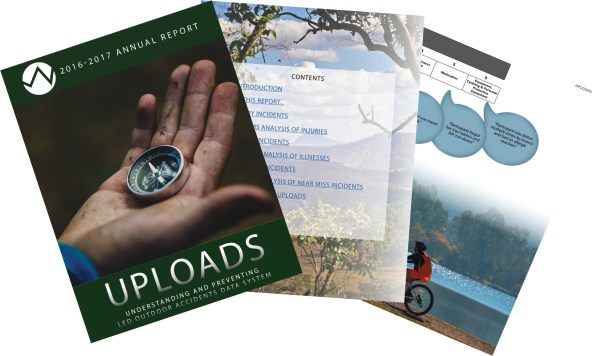 The UPLOADS Project team is excited to present the latest National Incident Dataset Annual Report. This report follows the same structure you know and love, but this year we have presented your 2016-2017 injury, illness, and near miss data in a new and exciting format!
Without further ado, please enjoy your latest UPLOADS report:
To see the new vibrant GRAPHIC REPORT, click HERE
For a written SUMMARY of the report, click HERE
To get it at a glance, view an infographic POSTER HERE
This project was supported by funding from the Australia Research Council (LP150100287) in partnership with our wonderful industry partners.
We would like to thank those organisations and our funding partners. This dataset represents a huge contribution of time and effort from the organisations involved, both in terms of data collection and maintaining the quality of the reports.

With a new online reporting system just around the corner, we would like to encourage the LOA organisations of Australia to consider contributing to the UPLOADS National Incident Dataset in 2018. To register you interest, please click here.
If you have any questions about this report or would like to contribute to the UPLOADS National Incident Dataset please contact the UPLOADS Project Team (uploadsproject@usc.edu.au).
 The UPLOADS team is delighted to announce that the redevelopment of the UPLOADS data collection tools has begun! We have listened to the feedback from our contributing organisations and are in the process of making the UPLOADS program more accessible and easier to use. Some of the design features of the new UPLOADS tool will include:

The redesigned UPLOADS tool is scheduled to be ready for release mid-2018*. Subscribe to our blog at uploadsproject.org for updates on the progress and release date for this exciting development! Please join us in thanking our industry partners, without whom, this project would not be possible!


Last month, the UPLOADS team held an initial workshop with safety management experts from the led outdoors to design an ‘optimal process’ to guide the development, selection, and prioritisation of incident prevention strategies for the led outdoor sector. From this workshop, a draft process was developed, and we need your help to make sure that it reflects the opinions and requirements of led outdoor providers from across Australia.
The UPLOADS team invites you to participate in a survey, which aims to ensure the opinions and needs of the wider Australian led outdoor sector are reflected in the incident prevention strategy development process that is being developed as part of the UPLOADS project.
Specifically, we want to know:
Eligible participants must work within an LOA organisation, and managing incident data or developing incident prevention strategies should be part of your role. This survey should take no more than 45 minutes to complete and is entirely voluntary.
Happy to help.
Thank you for your interest in our research. If you have any questions regarding this project you can contact us either by email (uploadsproject@usc.edu.au) or by phone (07 5456 5904).
The UPLOADS Project Team invites you to contribute to designing a practical process for translating incident data into appropriate and effective prevention strategies for LOA providers.
Designing the new process will involve two full day workshops.
Workshop 1 – 9:30am Wednesday 4th October 2017, Melbourne
Workshop 2 – 9:30am Tuesday 21st November 2017, MelbournePOSTPONED
We recognise that this is a significant time commitment, however this is required to effectively translate existing knowledge into a process that is both practical and aligns with the values of the LOA sector. The process will be integrated into the existing UPLOADS reporting system, and will be available for all LOA providers to use. We hope that this should have significant safety benefits for the LOA sector. In addition, through the workshop, you may gain insights that you can use to improve current processes in your organisation.
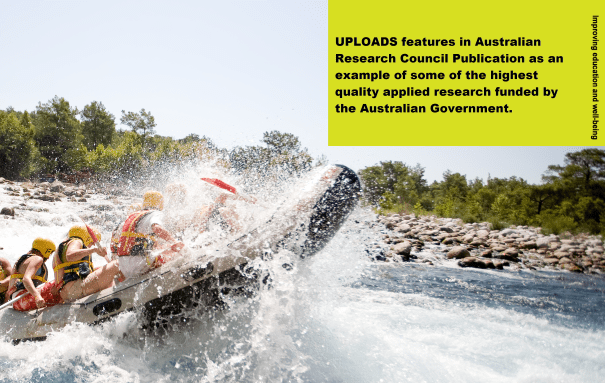
It gives us great pride and pleasure to let you know that UPLOADS has been included in the new Australian Research Council ‘Making a difference’ publication. This publication is a snapshot of some of the outstanding research outcomes derived from research projects funded by the Australian Government through the Australian Research Council (ARC) National Competitive Grants Program (NCGP).
This is an amazing achievement – essentially it means first that USC see UPLOADS as their flagship ARC research program, and second that the ARC see it as one of their most impactful research programs.
This is a testament to the strong partnership we have between researchers and practitioners and the innovative world leading and impactful research program that this relationship supports. It is amazing to think that in just 8 years we have gone from a small literature review to two major ARC grants with national and international impact.
As we enter the next phase of UPLOADS 2 this is a timely reminder of just how important this research is and of how widespread the impact can be. It is a pleasure to be a part of it all, and we are very grateful for the ongoing support of our industry partners, contributing organisations, and the Australian led outdoor sector!
To view the publication, click HERE. The article on the UPLOADS project can also be found on the ARC website.

by claredallat

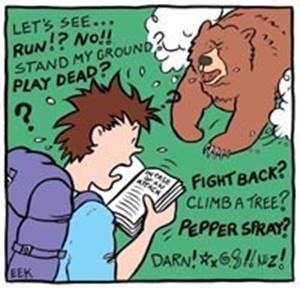
“Curriculum development, and our collective approach to facilitating learning in the outdoors has evolved significantly in the past few decades. However, in my opinion, the same cannot be said about how we manage risk. If we are honest, we’ll see that we are still teaching, promoting and defending positions relating to predicting and managing risk that were developed and advocated several decades ago. We still largely and wholeheartedly, hold onto the perspective that a well-trained individual, the instructor, is the determining factor in the safety outcomes of a program or activity.
For us, as outdoor education managers and leaders, our questions and intentions following an incident should not be to find out, why on earth our staff did what they did, but rather attempt to understand, why did it make sense for them at that time, to do what they did”.
Are we now willing, as a profession, to consider entering into alternative dialogues in relation to how we choose to understand accidents, and identify sources of risk in our work”?
The attached article provides an alternative and insightful perspective to identifying and managing sources of risk in a way that aligns with what the wider field of safety science now understands about how and why accidents happen. Using learnings from safety-critical domains such as aviation, healthcare and transportation, the author offers practical and implementable strategies for those involved in the design, planning and implementation of outdoor education and recreation experiences.
Clare has over twenty years of field and management experience in facilitated outdoor experiences, and is currently completing her PhD in Human Factors (risk assessment) at the Centre for Human Factors and Sociotechnical Systems, The University of the Sunshine Coast, Queensland, Australia (www.hf-sts.com). She is the Head of Innovation at The Outdoor Education Group.(www.oeg.org.au).

The UPLOADS Project team is excited to present the latest National Incident Dataset Annual Report. This report follows the same structure you know and love, and presents the injury, illness, and near miss data that was collected over the past year (June 2015-May 2016).
To aid in the distribution of the report’s findings, we present this report to you in four complimentary formats this year.
Read the full standard report HERE
Need the quick and simple version? Find a summary of the full report HERE
Don’t feel like reading? Watch a brief overview of the report HERE
Or to get it all at a glance, view an infographic poster HERE
This project was supported by funding from the Australia Research Council (LP150100287) in partnership with our wonderful industry partners.

This dataset represents a huge contribution of time and effort from the organisations involved, both in terms of data collection and maintaining the quality of the reports. We would like to thank those organisations and our funding partners. We would also like to urge others to contribute data in future. A larger sample size would allow for more firm conclusions to be drawn regarding the management of risk within the sector and the selection of appropriate targets for prevention strategies.
If you have any questions about this report or would like to contribute to the UPLOADS National Incident Dataset please contact Dr Amanda Clacy by email at aclacy@usc.edu.au or by phone +617 5456 5904.

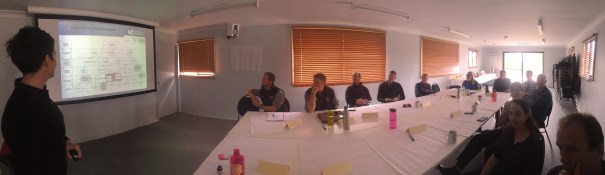
The conference kicked off with a pre-conference workshop hosted by the UPLOADS team. The aim of this workshop was to provide practical guidance on injury prevention in the delivery of led outdoor activity programs. Specifically, we engaged practitioners in a discussion about injury causation and prevention, and to support practitioners in translating the UPLOADS research in practice. This also involved a sneak peak of the new UPLOADS National Incident Dataset statistics. Thank you to everyone who engaged with us during this workshop! I think we all walked away from the workshop feeling inspired and motivated!
“It became apparent very quickly that this wasn’t going to be just another run-of-the-mill conference…”
Dr Mandi Baker‘s opening keynote raised some big questions about what makes a good leader? Can soft skills be taught? How important is “fun” the led outdoors? It became apparent very quickly that this wasn’t going to be just another run-of-the-mill conference as many of the delegates offered points of discussion from their real, experience-driven points of view.
In the session workshop presented by Dr Amanda Clacy, there was a similar response from the delegates. After opening the session with some of the new data from the National Incident Dataset, practitioners were quick to engage in an open conversation about the current constraints in the reporting culture in the led outdoors. The group also came to discuss the importance of reporting rich and consistent information to be able to better understand the factors leading to incidents and to develop appropriate prevention strategies to be able to reduce future risk.

On the final day of the conference we were very fortunate to be provided with a stand out keynote presentation from an exceptional ‘outdoor edder’, Clare Dallat. There wasn’t a dry eye in the house after the humorous, moving, and honest presentation in which Clare encouraged us all to look beyond some long-held assumptions and beliefs with the aim of better serving the people in our care by becoming the very best versions of ourselves. Through sharing her own story of evolving over almost 15 years, Clare imparted 10 valuable lessons to us all:
There were so many relevant, practical, and informative workshops delivered by the experts in their field. This is what made this conference so outstanding. Over the 3 days we spent at Camp Wombaroo at this practitioner’s conference, I became more and inspired by the work our ‘outdoor edders’ do. This genuinely is a tribe of people who are determined and willing to really develop their community.


